The Results Are In: Eat Real certification improves academic performance
Ask any athlete, surgeon, or working mom and they’ll tell you they perform better when they eat better. But anecdotal evidence is not a strong enough foundation for policy transformation. The game-changer is authoritative data.
That’s why Eat Real is excited to share the new peer-reviewed paper authored by Dr. Michael Goran, Director of the Nutrition and Obesity Program at Children’s Hospital Los Angeles and and his postdoctoral research associate, Alexandra Descarpentrie, and co-authored by Eat Real co-founders Dr. Robert Lustig, UCSF pediatric neuroendocrinologist and chief science officer of Eat Real and Dr. Jordan Shlain, Private Medical, published in Public Health Nutrition.* The study compared academic outcomes in 49 Eat Real certified school districts with the outcomes of nearly 2,500 non-certified control schools.

The results? The study found that the Eat Real certified schools saw the proportion of students meeting or exceeding English Language Arts standards increase by 5.51%, and those gains have remained over the three years since the study was initially conducted. The study also found similar trends in mathematics.
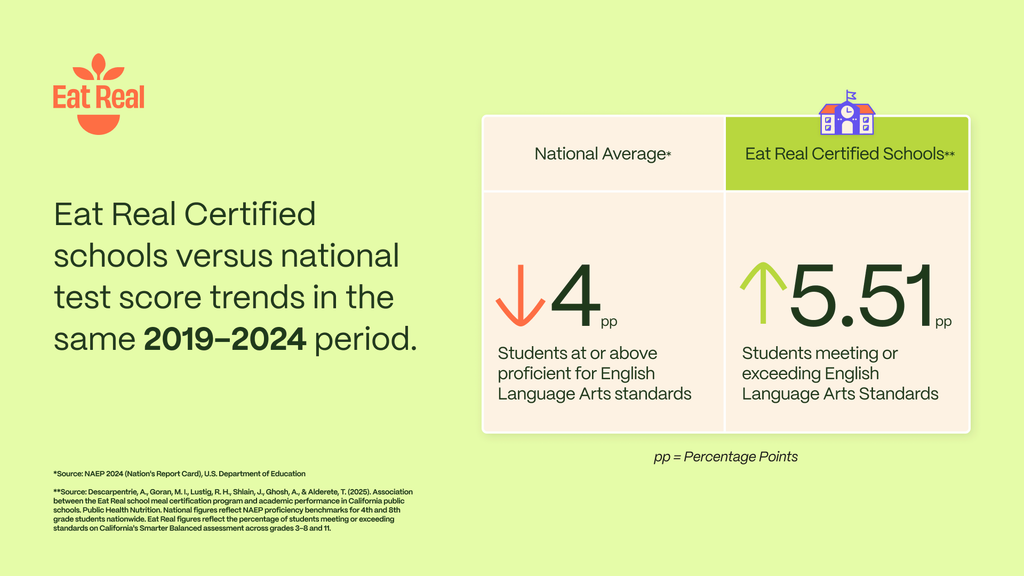
What Does It All Mean?
The study is among the first peer-reviewed analyses that demonstrates a link between a school nutrition certification program and measurable outcomes, independently validating Eat Real’s K-12 certification model.
As our CEO Nora LaTorre put it:
“For years, school food has been treated as separate from the classroom. This research shows that improving school cafeterias can help improve academic outcomes.”
“These findings add to growing evidence that children’s nutrition influences more than just physical health,” said study co-author Dr. Goran, “In our previous research, we found that greater exposure to ultra-processed foods during the first six years of life was associated with smaller volumes in several brain regions involved in emotion, motivation, and behavior. Together, these studies suggest that creating healthier food environments—from infancy through the school years—may support children’s brain development, learning, and long-term health.”

Methodology Matters
When it comes to children, there are so many factors that affect academic performance it can be very hard to determine which ones are real catalysts and which ones are just along for the ride. The study designers, led by Dr. Michael Goran and his postdoctoral research associate, Alexandra Descarpentrie, knew this to be the case. So the team built their study around a staggered difference-in-differences design. It’s a method chosen specifically to rule out the more obvious alternative explanations.
A simple before-and-after comparison wouldn’t have been enough, since test scores shift year to year for reasons that have nothing to do with school food, like new curriculum, funding changes, and demographic shifts. And a simple comparison between certified and uncertified districts wouldn’t have been enough either, since districts that pursue certification might already differ in ways that show up in test scores.

The staggered design addresses both issues. Because different districts adopted Eat Real certification in different years, researchers could track each district against its own history — before and after certification — while comparing that trajectory to uncertified districts moving through the same calendar years. A shift that shows up only in certified districts, only after certification, and only relative to what similar districts were doing at the same time, is much harder to explain away as coincidence or outside trend.
This methodology isolated the adoption of Eat Real certification as the catalyst. That’s causation, not mere correlation!
Going Forward
We already know that 30 million children in the U.S. rely on school meals for a significant portion of their daily nutrition.* We also know that more than 67% of children’s calories come from ultra-processed foods.** And now we know that Eat Real certification has a statistically significant impact on learning outcomes.
“These findings represent an important milestone in the growing body of evidence connecting nutrition and student academic performance,” said Dr. Robert Lustig. “Eat Real became necessary because children were getting sick and no one in a position of power had the knowledge, desire, or agency to fix it. Test scores have fallen across the country for decades as ultra-processed foods in school have increased. This study is the academic evidence that our Eat Real model works—that real food in schools produces measurably better academic outcomes for kids.”

Since launching its certification program in 2019, Eat Real has more than doubled its impact, partnering with over 1,900 schools across 63 districts nationwide and reaching over one million students. Help us spread the word that better nutrition means better academic results, lowers disease risk, and tastes great. That’s a delicious win win win.
The study was supported in part by the NIH-funded Southern California Center for Chronic Disease Research and Prevention (NIMHD P50 MD017344). Eat Real reviewed the manuscript but did not provide financial support and had no role in the study design, data analysis or interpretation of findings.
* Source: JAMA
** Source: Tufts Daily (Tufts University)